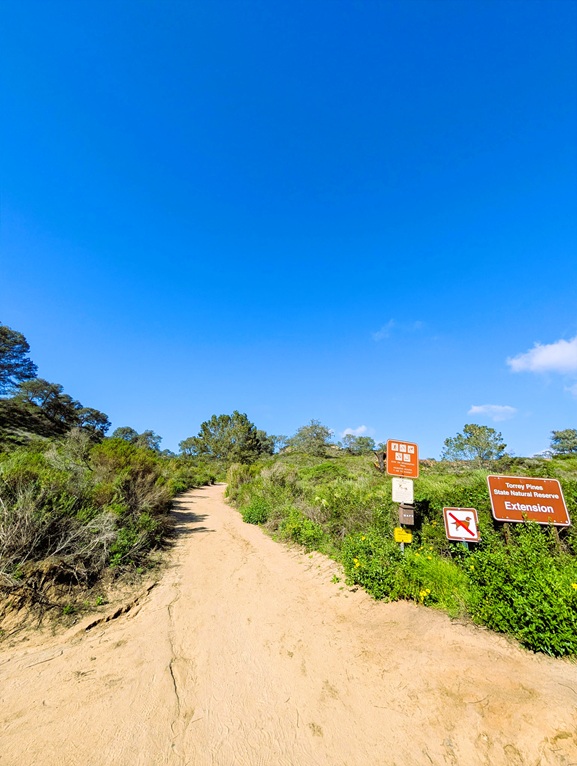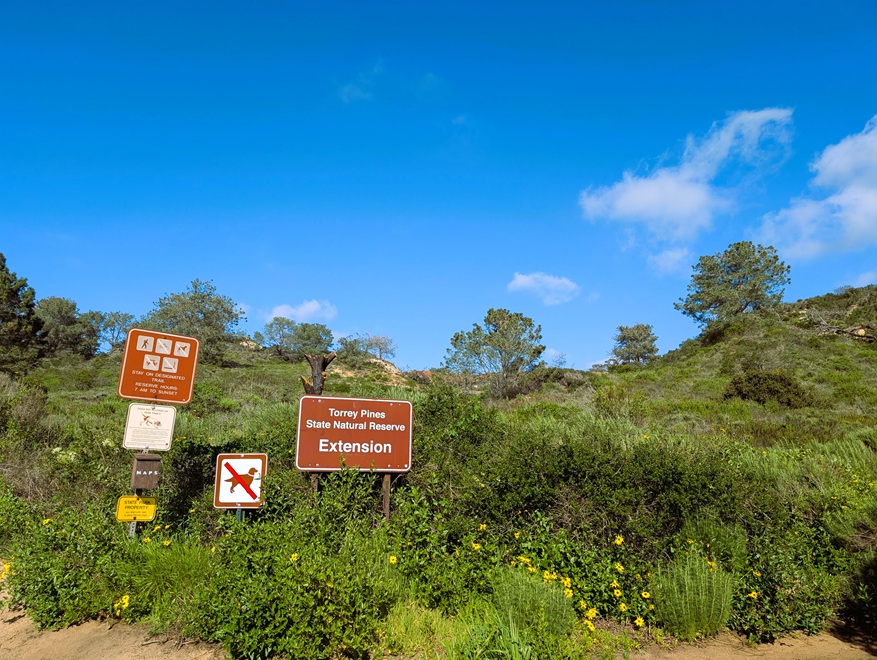
Most people who visit Torrey Pines never make it to the Extension — and that is precisely what makes it so special. Here you find genuine solitude, extraordinary botany, and something truly rare in this world: a tree that grows in just two places on earth. I came to Torrey Pines Extension specifically to meet that tree. What I found was so much more.
Sara Orangetip Butterfly on Common Fiddleneck
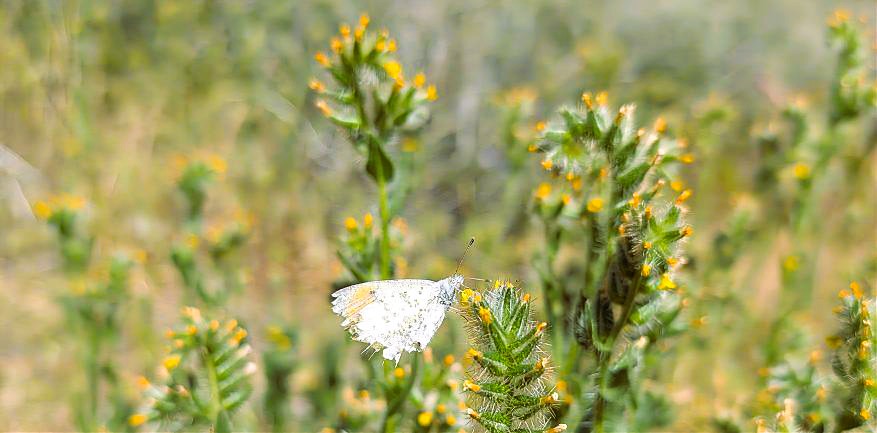
This is one of my favorite photographs I have ever taken. The Sara orangetip (Anthocharis sara) is a small, delicate butterfly whose brilliant orange wingtips make it instantly recognizable in flight. Here it has landed on Amsinckia intermedia — common fiddleneck, named for its gracefully curling flower spike. To catch a moment like this — butterfly, wildflower, and golden coastal light all converging at once — is the kind of gift that makes you stop breathing for a second. I was very still, and very grateful.
The Torrey Pine — A Tree Like No Other
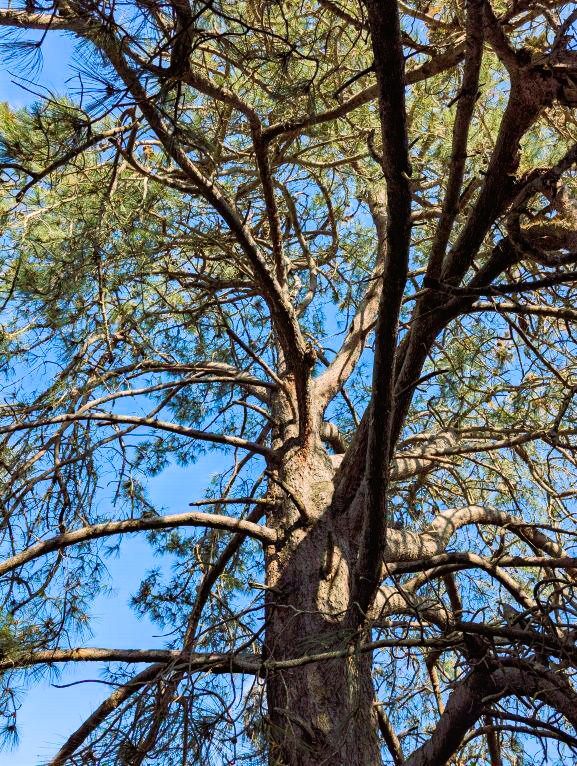
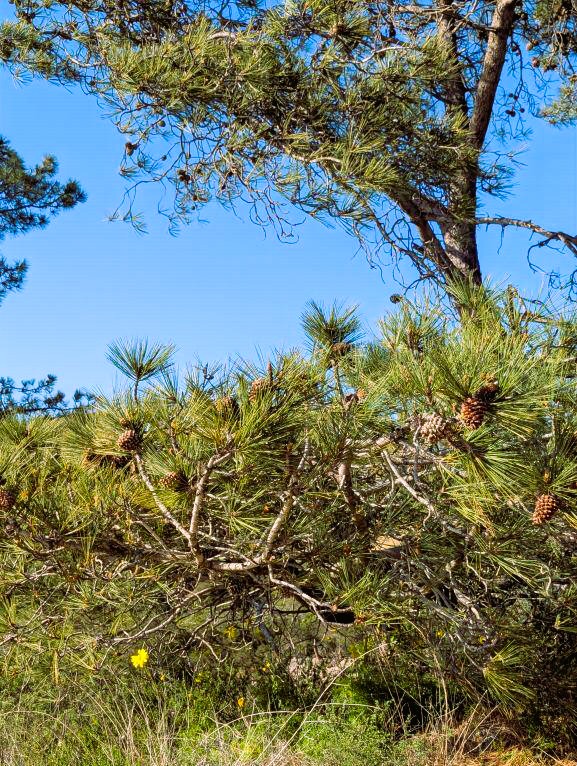
Trees are my friends. I mean that sincerely. I love spending time among the trees in my yard and traveling to beautiful places to see and be with trees I've never met before. That love of trees was a large part of what pulled me to Torrey Pines Extension — because growing here is one of the rarest pine trees on earth. Pinus torreyana, the Torrey pine, puts down roots in exactly two places in the world: this stretch of California coastline, and a small island off Santa Barbara. Nowhere else.
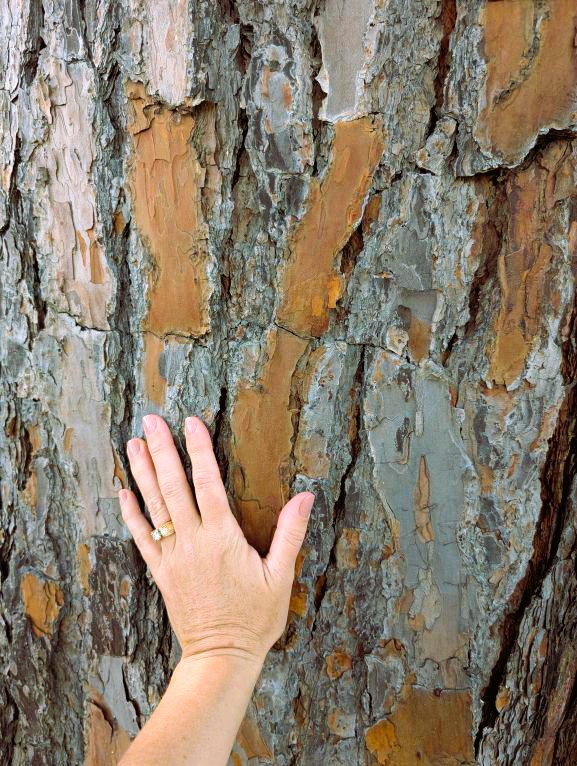
Gnarled and sculpted by decades of Pacific wind and sea, each tree feels less like a plant and more like a personality — ancient, resilient, and deeply rooted in its place. I found myself standing at the base of one and pressing my hand against the bark, just to feel how real and alive it was. Standing beneath one of these trees, you feel the full weight of geological time, and somehow also completely at home.
The Torrey Pine Cone
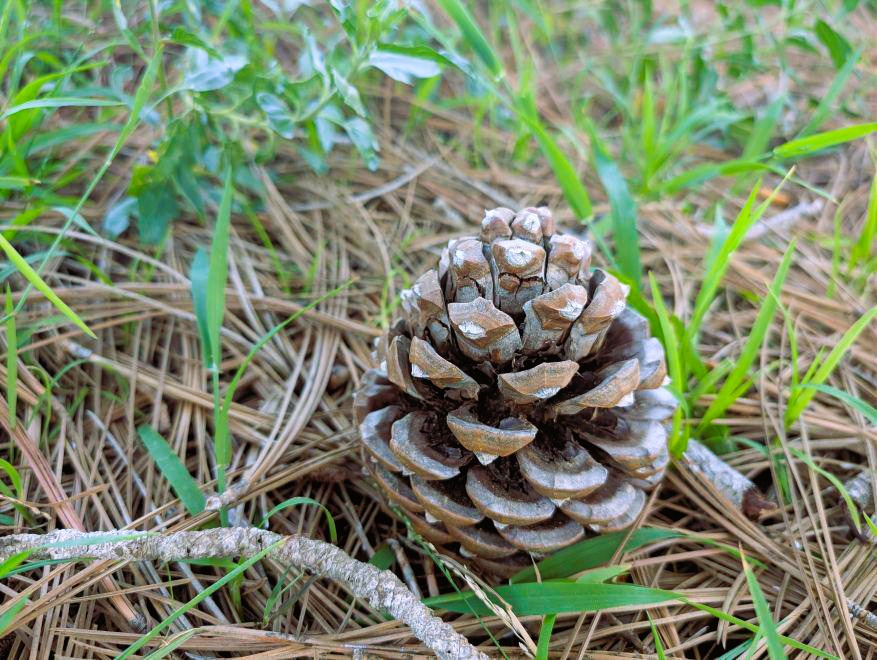
The Torrey pine cone is something to behold — heavy, woody, and substantial, with thick scales that curve into almost architectural forms. These cones can remain on the tree for years before opening, a slow patience that mirrors the unhurried nature of the tree itself. Finding one on the ground felt like discovering a small treasure. I held it for a long time before setting it back down where I found it.
The Path — and What Awaits at the Top
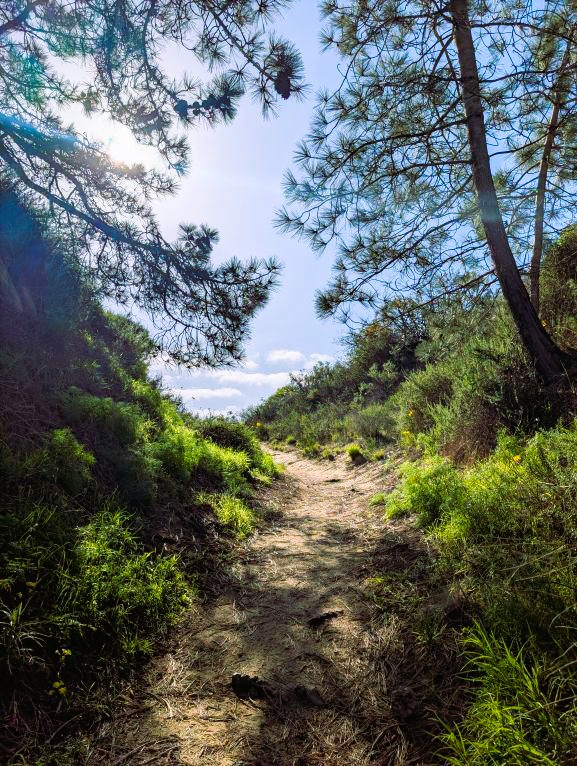
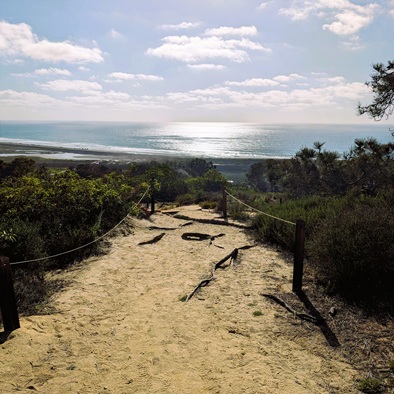
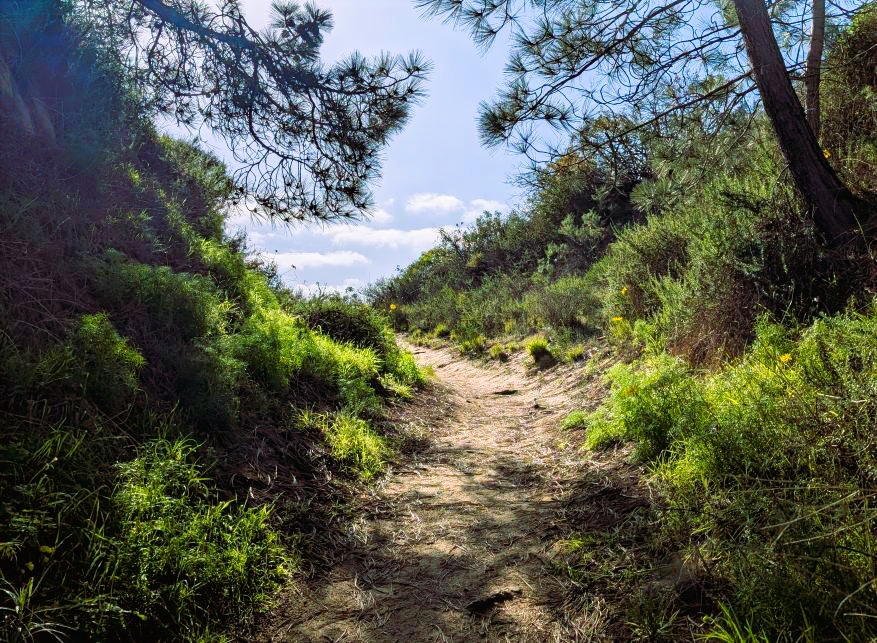
There is something about a winding path disappearing over a hill that is almost impossibly inviting. This one winds up and over, with the Pacific glinting on the other side and towering Torrey pines standing sentinel along the ridge. I followed it without hesitation. That is exactly the kind of adventurer I am.
And when you reach the top — this is your reward.
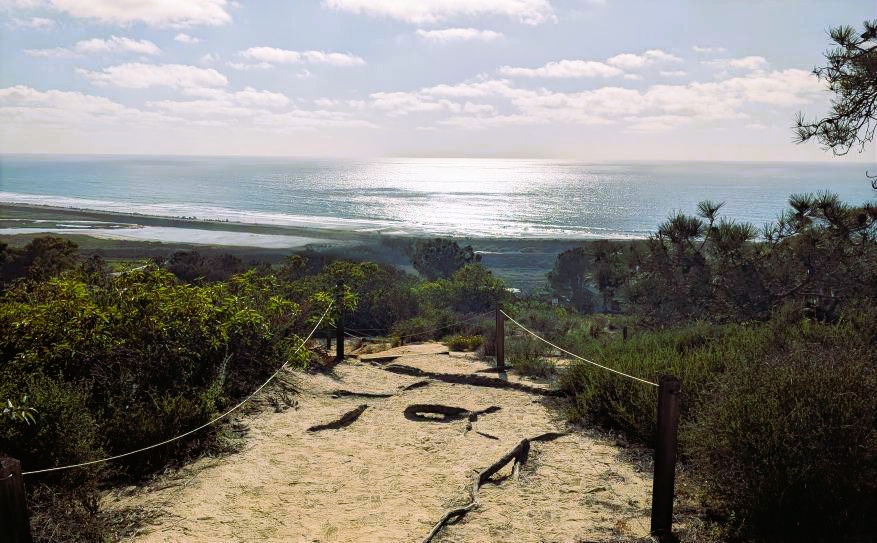
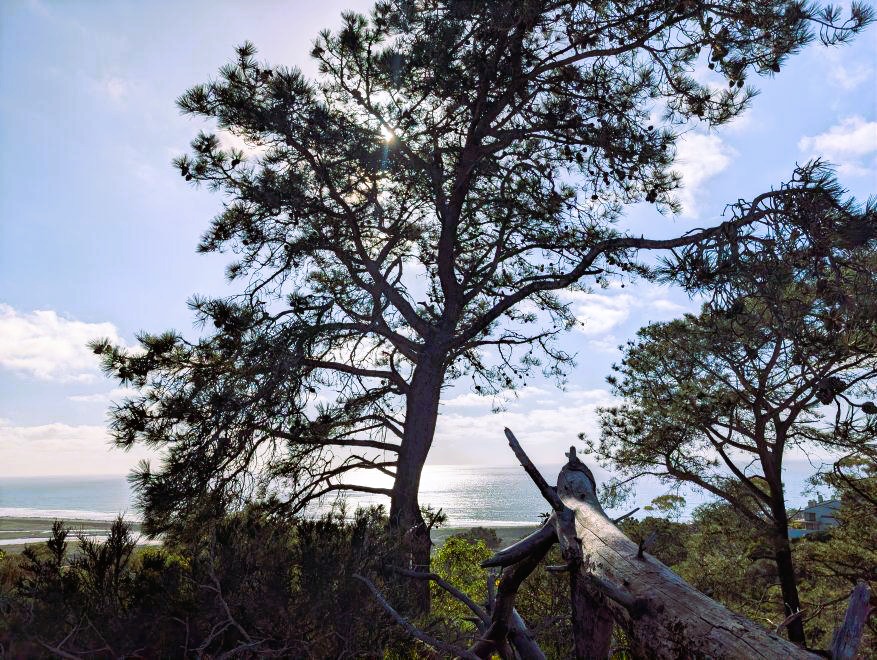
Towering Torrey pines, the Pacific stretching out endlessly behind them, coastal light wrapping everything in gold. You climbed a hill to get here, and the view is your prize. Moments like this are exactly why I travel to meet new trees in new places — because sometimes the tree and the ocean and the path all come together at once, and it takes your breath clean away.
Coastal Bush Sunflower — Encelia californica
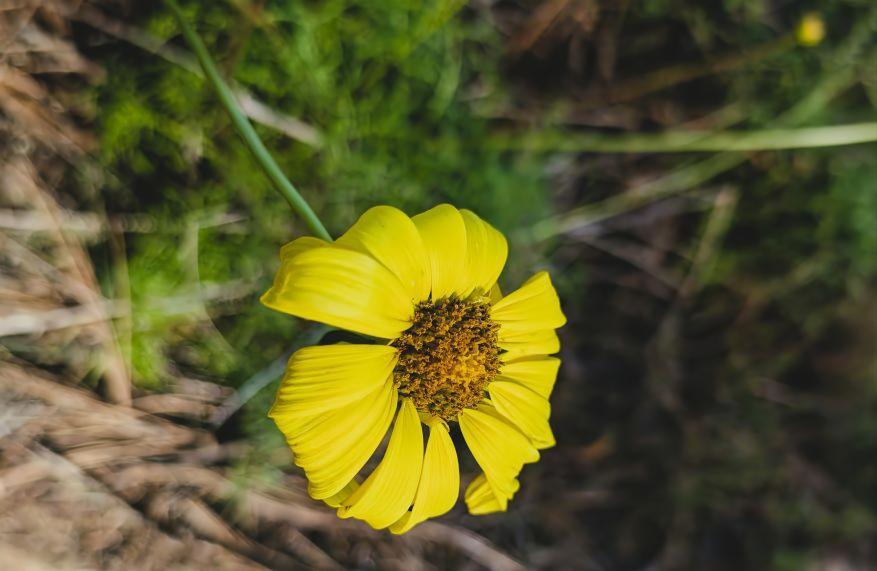
Encelia californica — the California brittlebush or coastal bush sunflower — was everywhere along the trail, its bright yellow daisy-like blooms catching the coastal light beautifully. A signature plant of California coastal sage scrub, it thrives in exactly the kind of exposed, sun-drenched bluffs that define Torrey Pines Extension. Cheerful, resilient, and deeply at home here.
Encelia californica — California Brittlebush
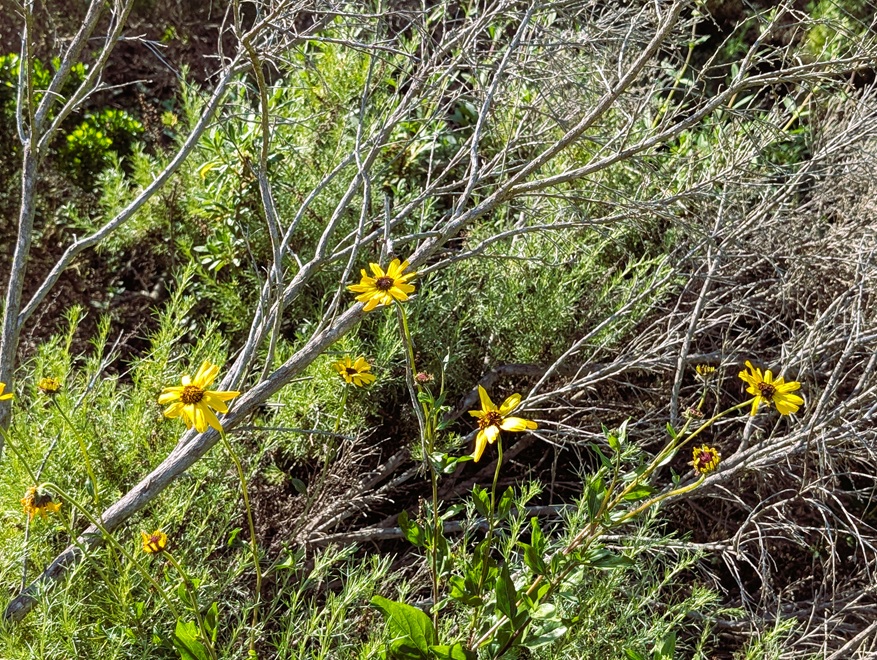
A second, wider view of Encelia californica shows just how abundantly this plant carpets the coastal bluffs in spring. Growing in loose, sprawling mounds with silvery-green leaves, the brittlebush earns its name from stems that snap cleanly when bent. Spanish missionaries in California discovered that the plant's aromatic resin produced a richly fragrant smoke when burned — so much so that they used it as a substitute for frankincense in their services, giving the plant one of its other common names: incienso. A plant with both beauty and a fascinating story.
Coreopsis — Tickseed Wildflower
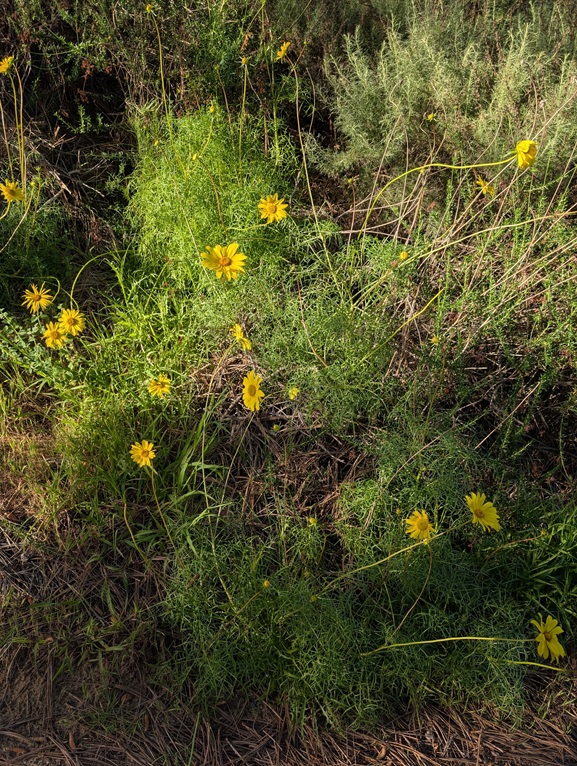
Coreopsis — commonly called tickseed — adds a burst of pure golden yellow to the coastal palette. Its symmetrical ray flowers have a precision and brightness that almost seems too perfect to be wild, yet here it grows freely among the rocks and scrub of the Extension trail. A cheerful and underappreciated native wildflower that deserves far more attention than it typically gets.
California Fuchsia — Epilobium canum
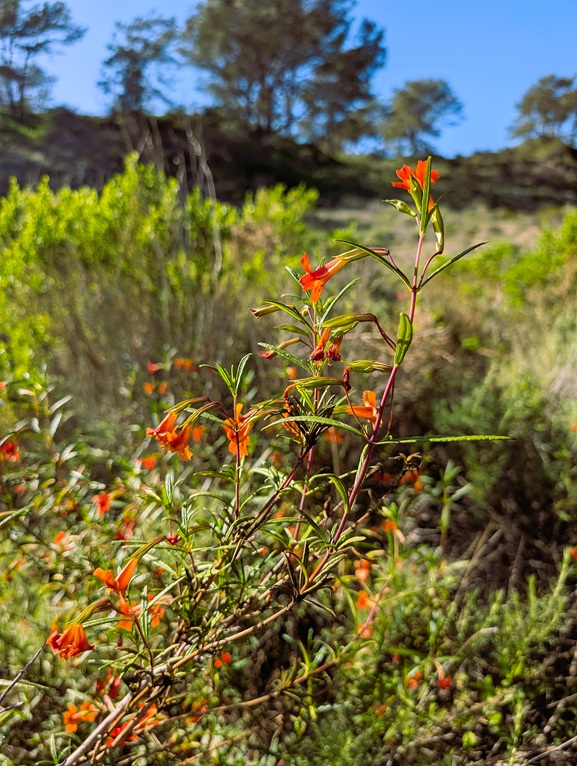
Epilobium canum, the California fuchsia, announces itself in brilliant scarlet-orange — a vivid contrast against the muted greens and grays of coastal sage scrub. A favorite of hummingbirds, it blooms late in the season when many other wildflowers have faded, providing a vital late-season nectar source. Finding it in bloom at Torrey Pines felt like a small bonus gift on an already extraordinary day.
Foothill Penstemon — Penstemon heterophyllus
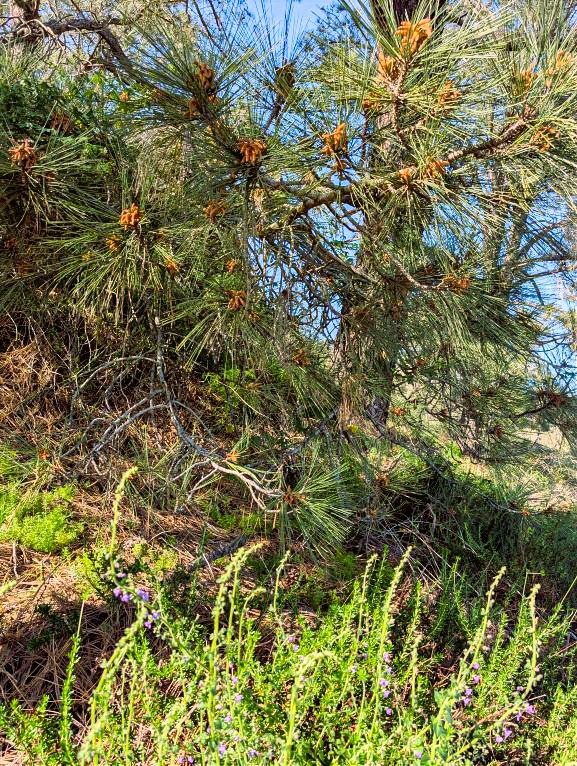
Penstemon heterophyllus — the foothill penstemon — produces striking tubular flowers in shades of violet and blue-purple, here caught in beautiful proximity to one of the great Torrey pines. Penstemons are native bee magnets, and this one is no exception. The combination of the wildflower in the foreground and the ancient pine rising behind it captures something essential about what makes Torrey Pines Extension so extraordinary — layers of beauty, one behind the other.
Manroot — Marah macrocarpa
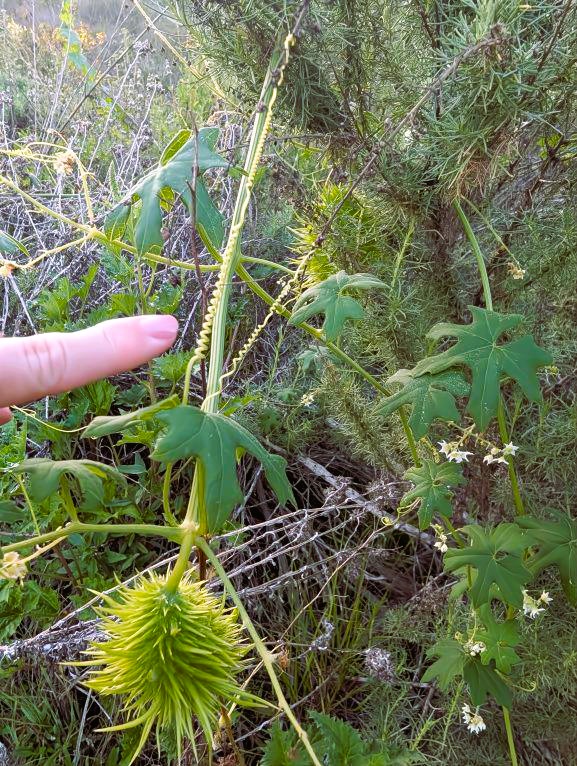
Marah macrocarpa — known as manroot, bigroot, wild cucumber, or chilicothe — is a vigorous native perennial vine with a personality far larger than its delicate-looking tendrils would suggest. It is native to Southern California and northern Baja California, growing in coastal scrub, chaparral, and oak woodlands, and it is very much at home along the bluffs and trails of Torrey Pines Extension.
The name "manroot" is no exaggeration. Underground, this vine develops a tuberous root of almost mythic proportions — growing slowly for decades until it can weigh several hundred pounds and span several feet across. These are not roots so much as underground monuments. The tuber is the plant's anchor and its savings account, hoarding water and energy through California's long, dry summers so that when the first rains of autumn arrive, the vine can surge back to life almost overnight — growing so fast on good days that you can practically measure its progress from one morning to the next.
The genus name Marah has a biblical origin: it comes from the Hebrew word for bitter, the same word used in the book of Exodus for the undrinkable waters the Israelites encountered in the desert. Botanist Albert Kellogg chose it in 1855 as a reference to the intensely bitter flavor found throughout the entire plant — a bitterness caused by toxic compounds called cucurbitacins. Macrocarpa pairs two Greek words meaning large and fruit, nodding to the plant's impressively oversized spiny seed pods. Despite sharing a common name with the cucumber you find in salads, this plant bears no culinary resemblance — every part of it is poisonous and must not be eaten.
The indigenous peoples of Southern California found many practical uses for this plant over generations. The smooth, hard seeds were polished and worn as ornaments or used as game pieces. The root was applied externally as a remedy for joint pain and rheumatism. Some California tribes discovered that manroot pounded and introduced to slow creek water could stun fish — making them easier to gather by hand. The fruits, despite their toxicity, were used medicinally in small amounts as a powerful purgative. This is a plant that was deeply known and thoughtfully used by the people who lived alongside it for thousands of years.
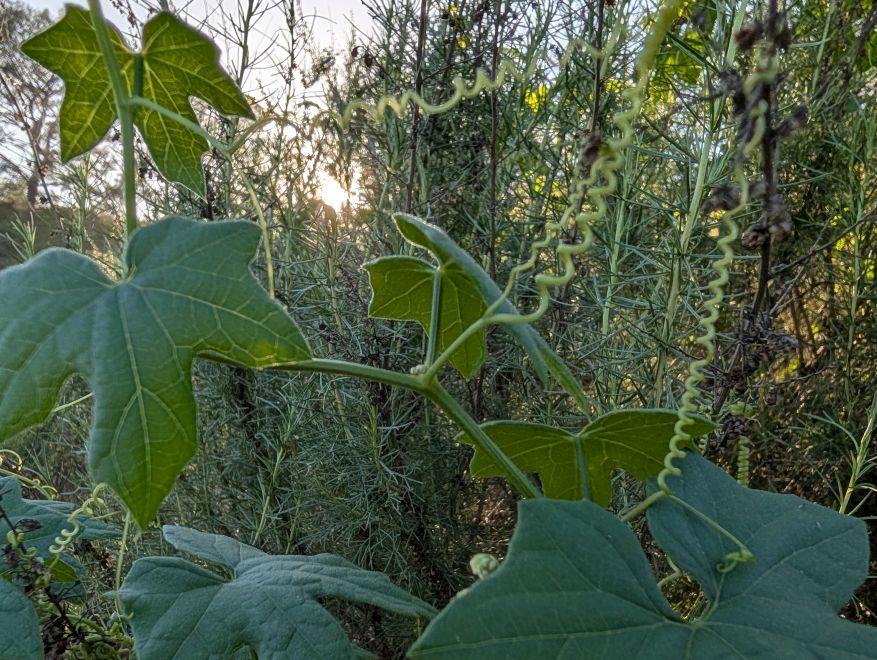
The curling tendrils of the manroot are one of its most visually striking features — spiraling outward with an almost geometric precision, reaching and grasping at anything nearby. The vine can scramble up to 20 feet in length, clambering over shrubs and coastal scrub with cheerful abandon. Each tendril is a small work of art in its own right, elegant and purposeful at the same time. I found myself stopping on the trail just to look at them for a while.
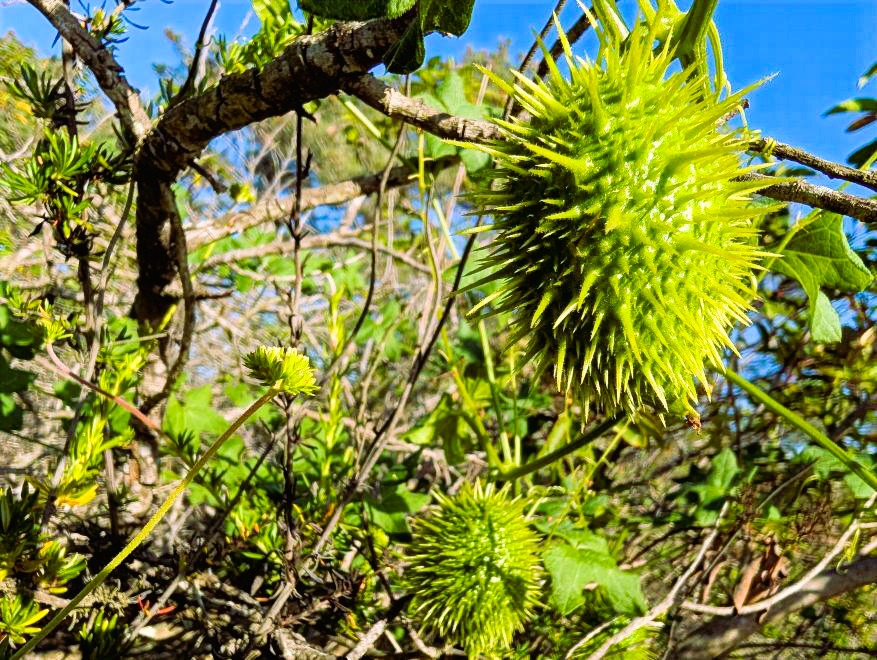
Here the manroot's spiny fruit is clearly visible — distinctive green spheres covered in soft spines that look almost playful up close. These fruits are technically toxic, which perhaps explains why they are left largely undisturbed on the vine to dry and release their seeds. As with so many plants I encounter in the wild, there is both beauty and a quiet warning here — nature's elegant way of protecting itself.
Torrey Pines Extension Gallery
Click any image to open it full size.